
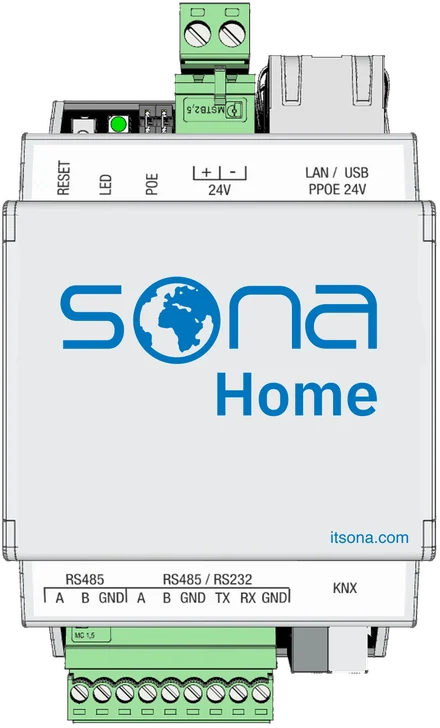
Sona Home brings every system in the home together in a single device, runs its visualization, its logic, its schedules and its data logging on itself, and takes up three modules in the electrical panel: an automation server.

One device, four jobs
The server does four jobs in one box. It translates between different protocols. It runs the logic and the scenes. It serves the visualization itself. It records the data and moves it out. None of this needs a second device or software installed on a computer.
What comes in the box
Everything below comes with the device. There is no extra product to buy.
Visualization
- Live visualization on the floor plan
- Drag-and-drop editor
- Desktop and mobile views from the same design
- Template management; a template change flows to every page that uses it
- PNG, GIF, JPG and SVG graphics support
- Interactive objects such as sliders, spinners and toggles
- Color, text and shape change according to state
- RGB and color temperature controlled together
- Custom widgets and pop-up windows
- Embedded camera image
- Delivered with your own logo, colors and icons
- Access from the browser; no client to install
- Full-screen kiosk mode
- Multilingual interface
User management
- Multi-user access
- Each user sees only the pages, trends and schedules they are entitled to
- The homeowner does not see the engineering interface
- A separate set of graphics per user
Logic and scenes
- Four script types: event, resident, scheduled and start-up
- Block diagram editor; build logic without writing scripts
- Custom block design
- User libraries
- Scenes and delays between commands
- The homeowner can save their own scenes
- Write-on-change to keep the bus load down
- Central status functions: and, or, average, sum, maximum, minimum
- PID control
- Staircase timer and delay counters
- Short and long press, single and double press detection
- Blind controller
- RGB splitting and merging
Time
- Weekly schedules
- Holiday calendar
- Public holidays loaded automatically
- Schedules tied to sunrise and sunset, without internet
- The homeowner can change the schedule themselves
Trends and reports
- Trend logging
- Multi-year retention
- Several trends compared on the same graph
- Daily, weekly and monthly views
- Excel and CSV export
- Scheduled automatic reports
- Archiving by email and FTP
Alarms
- Real-time alarm list
- The page comes to the front by itself when an alarm occurs
- Audible alert
- Acknowledgment and action trail
- Alarm history
- CSV download
- Sending to email and FTP
Notifications
- Email; can send attachments
- Mobile notifications, Android and iOS
- SMS
- Telegram
- Built-in email server
Remote access
- Remote connection without a static IP
- Mobile app
- KNX programming with ETS without going to site
- Remote service interface
Voice assistants
- Amazon Alexa
- Google Assistant
- Apple Siri and HomeKit
- Whatever is in the system reaches the voice assistant, whatever protocol it is connected over
System
- Backup and restore
- Scheduled automatic backup
- Remote software updates
- Project templating and duplication
- Role-based permissions
- Application store
Runs locally
- The system does not stop when the internet drops
- Data stays on the device
- No telemetry and no user data collected

What it connects to
The server handles the protocols itself; there is no extra converter in between.
- KNX
- BACnet
- Modbus
- MQTT
- SNMP
- HTTP/REST
- DMX512
- DALIgateway
- Zigbeegateway
- Z-Wavegateway
- M-Busgateway
- EnOceangateway
TCP and UDP over IP, RS-232 and RS-485 serial lines, infrared converters and relay and dry contact modules are used as well.

Systems verified by name
- Philips Hue
- lighting, connects directly
- Casambi
- lighting, connects directly
- Sonos
- multiroom audio
- PJLink
- projector control
- Shelly
- device family
- CoolMaster
- VRV and VRF air conditioning systems
- Amazon Alexa · Google Assistant · Apple Siri and HomeKit
- voice assistants
- ZeroTier · OpenVPN · WireGuard
- remote access
These names belong to their respective manufacturers; the connections were developed by Sona.
The full list of device families is on the Compatible Systems page.

What it does in the home
Lighting, blinds, climate and underfloor heating come together in one interface. A scene runs with one tap; a Good night scene shuts the whole house down. Door contacts, motion, water leak and smoke sensors build the security scene, and an alarm reaches the phone. The weather forecast is pulled from the internet and used to run scenes ahead of time. Multiroom audio and video systems join the automation. Devices that work with a remote, such as an air conditioner, come in through an infrared converter. Energy, water and heat consumption are trended over years.

It grows with applications
Everything above comes with the device. On top of that, applications are installed as the job requires: a music service connection, panel management, an alarm center. A second system is not built for a new job. All of the applications are on the Applications page.

Sona Home specifications
Sona Home carries up to 3,500 data points. A data point is every value monitored or controlled in the system: a lighting group, a thermostat, a sensor. The number comes out of the site survey.
| Data points | Up to 3,500 data points |
|---|
| KNX/TP | 1 |
|---|---|
| Ethernet (RJ45) | 1 |
| RS-485 | 1 |
| RS-485 / RS-232 | 1 (software-selectable) |
| USB 2.0 | 1 |
| Supply | 24 V DC (terminal) |
|---|---|
| Consumption | 1 W (minimum, with no external load) |
| KNX bus | Bus terminal, 0.8 mm² |
|---|---|
| Power and I/O | Screw terminals, 0.8 – 1.5 mm² |
| LED 1 | Green: system load |
|---|---|
| LED 2 | Green: normal operation · red: reset |
| Mounting | DIN rail |
|---|---|
| Module width | 3 modules |
| Dimensions (W × H × D) | 54 × 112 × 61 mm |
| Protection class | IP20 |
| Net weight | 108 g |
| EMC | EN61000-6-1 · EN61000-6-3 |
|---|
| Operating temperature | 0 °C … +45 °C |
|---|---|
| Storage temperature | −15 °C … +55 °C |
| Relative humidity | 0% … 93% (non-condensing) |
| Warranty | 2 years |
|---|
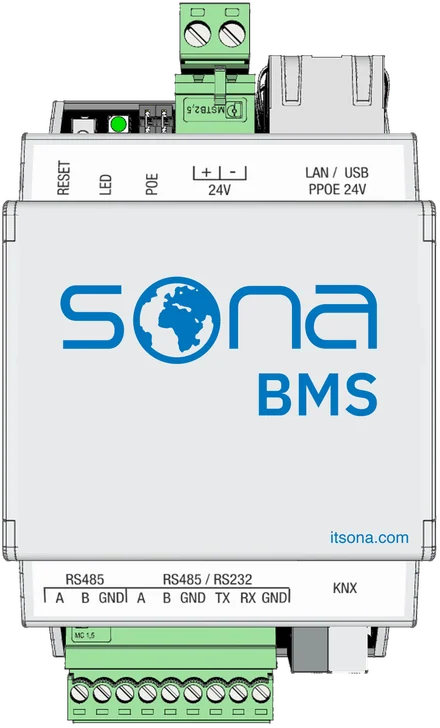
When Sona BMS instead
When the point count goes above 3,500, or the site spreads across more than one building, Sona BMS is the choice. The two servers run the same software; the difference is the point capacity.
Datasheet
- Sona HomeDownload the datasheet PDF
Frequently asked questions
Do I also need to buy SCADA software?
No. The visualization is inside the device; there is no screen package installed on a computer and charged separately.
Is there an extra charge as the point count grows?
No. Up to 3,500 points there is no per-point charge.
Does the home stop when the internet drops?
No. Scenes, schedules and panels keep working locally. A connection is needed for remote access and notifications.
Can the homeowner change their own scenes?
Yes. Scenes and schedules can be edited and saved by the end user.
Does it install on top of an existing KNX installation?
Yes. The server listens to and manages the existing line; the field devices do not change.
Can service be provided without going to site?
Yes. The server is reached remotely, and KNX programming with ETS is done remotely as well.
Become a Sona dealer.
Build your projects on a single platform. Training, technical support and the application catalog are open to our dealers.